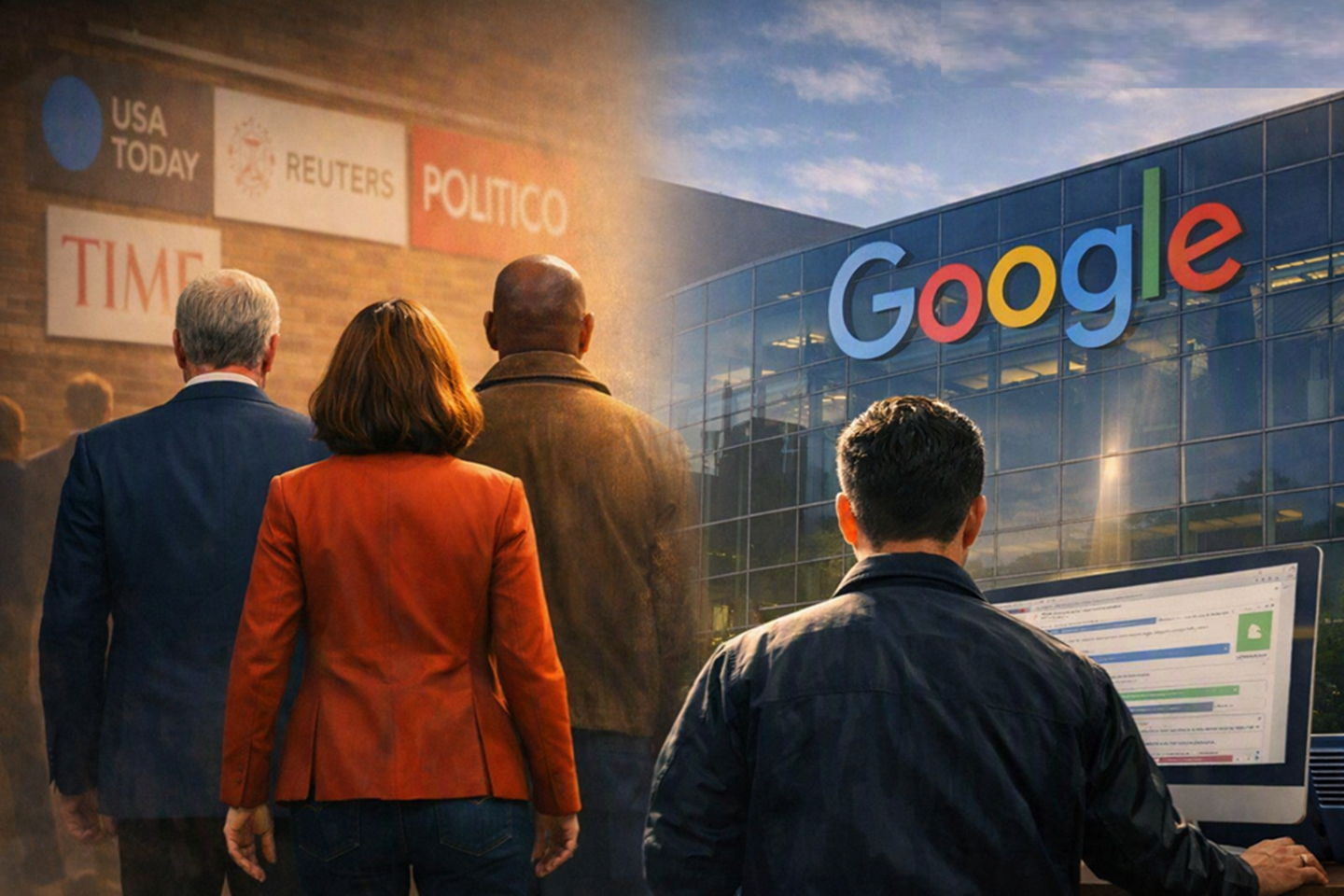
For twenty years, letting Google crawl your website was not really a decision. It was simply how the internet worked. Google indexed your pages, sent traffic back in return, and everybody carried on with their day. That unspoken agreement is now being tested by some of the biggest names in publishing, and the outcome could reshape how every business owner thinks about search traffic, not just the news industry.
The story so far
According to reporting from the Wall Street Journal, several major publishers, including USA Today, Politico, Reuters, The Economist, People, and Time, are seriously weighing whether to block Google’s crawlers from accessing their content altogether. Even Reddit, whose forums quietly power a large share of Google’s search results, has reportedly discussed cutting off Google’s access to its content for AI purposes.
The reasoning being given is blunt. USA Today Co’s chief executive has said the company feels it is time to take a stand, while the head of People Inc has confirmed that switching Google off entirely is genuinely on the table. Reuters put it more diplomatically, describing the decision as weighing the economic trade-off between search traffic and AI summaries. Not every publisher agrees, mind. The Economist’s vice president of generative AI pointed out that traffic, even when it is inconsistent, is still traffic worth having.
Why this is happening
Google’s AI-driven search results, delivered through features such as AI Overviews, now answer a growing share of queries directly on the results page. The person searching gets an answer without needing to click through to the publisher’s website at all. For a business that relies on advertising revenue or subscriptions, that shift removes much of the incentive to allow Google to consume its content in the first place. Google has responded to criticism of this kind by pointing to figures showing billions of clicks flow weekly through its AI-powered search features, though publishers watching their own traffic decline are clearly not fully convinced by that number on its own.
Data shared as part of the same reporting shows measurable drops in Google Search referral traffic across the publishers named above, adding hard figures to what many website owners have already suspected. Search behaviour is changing, and clicking through to the original source is becoming optional rather than automatic for the person doing the searching.
Why this matters beyond the news industry
It would be easy for a smaller business to read this story and assume it only concerns national newspapers and media groups with the scale to negotiate directly with Google. That would be a mistake. The pattern driving this decision, AI-generated answers reducing the need to visit the original page, applies to every website that depends on organic search traffic, regardless of size or sector.
A property finance broker publishing a guide to remortgaging, a manufacturer explaining a technical process, or a fashion photographer outlining pricing packages, all face the same underlying shift. Google may increasingly answer the searcher’s question directly from the page content, satisfying the query without a click ever taking place. The publishers named in this story simply have the audience scale and commercial leverage to make blocking a credible threat. Most businesses do not have that leverage, which means adaptation is the more realistic response, not confrontation.
What this means for your SEO strategy
Blocking Google is not a sensible option for the overwhelming majority of businesses, since organic search remains one of the most cost-effective ways to reach new customers. The more useful takeaway from this story is recognising that visibility and clicks are no longer the same thing, and planning around that reality rather than being caught out by it.
A few practical shifts worth considering:
- Structure content so the answer to a specific question sits clearly near the top of the page, since this is the format AI summaries tend to favour when selecting what to feature.
- Build content around topics where a person genuinely wants more detail than a short summary can provide, such as comparisons, case studies, and pricing guidance, rather than content that can be fully answered in two sentences.
- Track visibility across AI-driven results as well as traditional click-through rate, since a strong ranking paired with a declining click rate tells a very different story to a page that is simply underperforming.
- Strengthen other channels, including email, direct traffic, and referral partnerships, so the business is not solely reliant on Google’s goodwill for new enquiries.
The bigger picture
Whether any of these publishers actually follow through on blocking Google remains to be seen, and there is genuine commercial risk in doing so, given how dependent most of them still are on search traffic even as it declines. What matters more for most business owners is what this dispute reveals. The exchange between creating content and receiving traffic in return is no longer guaranteed, and businesses that plan their SEO strategy around that assumption today will be in a far stronger position than those that wait to be told.

Graig Upton is an SEO and Google Ads manager with two decades of hands-on digital marketing experience. Being certified in Google Ads, Analytics and Conversions, Graig has helped local providers to national brands getting their websites found for targeted key on search engines like Google and AI platforms.